Garden of Mnemonics (2026)
Made with ceramics, beeswax, reclaimed hardwood, circuits include attiny85, custom made pcbs with voltage detection & boost chips, buzzer, and basic electronic components.
This artwork is derived from research project ︎ Electric Garden
Credits
Project Initiation, Workshops Guidance, Making of the Art Installation
Sunjoo Lee
Fiction Writing, Ceramics
Ayşe Nur Akin, Matilde Calamandrei, Alexandra Cooke-Kasyanto, Faye Gin, Allegra Greher, Pieter H, Laura Häberli, Ko-Yu (Sara) Huang, Hwia Kim, Shary Kock, Sonia Srikuruwal, Magdalena Matlok, Vincent Rang, Noam Youngrak Son, Sunjoo Lee
Ceramics
Burcu Ekizoğlu, Tifène Huchet, Theun Karelse, Melissa van der Lingen, Werner de Valk, Fabian van Sluijs, Cate Tavagnutti, Joost Welling
Electronics
Ko de Beer, Nina Blume, Alexandra Cooke-Kasyanto, Adele Stroh, Inne Eysermans, Niels Graber, Yuxin Hu, Mark IJzerman, Byron Kalomamas, Shary Kock, Dewi Mac Donald, David Quartey, Marija Tiurina, Pier Woudstra
Co-guidance of Fiction and Ceramics Workshop
Noam Youngrak Son
Support for Electronics and Sound
Mark IJzerman, Ko de Beer
Adviser Electronics
Pim Swinkels
Voice for Narration
Alexandra Cooke-Kasyanto
Narrative Audio Sound Design, Mixing and Mastering
Mark IJzerman
General Production Support
Ko de Beer, Carolina Janssen
Wooden Structure Production Support
Frank de Beer
Garden of Mnemonics was commissioned by FIBER as part of FIBER Festival 2026 and with support of Mondriaan Fonds, AFK and Stimuleringsfonds.
It has been developed as part of the FIBER Reassemble Lab and with support from Zone2Source.
Made with ceramics, beeswax, reclaimed hardwood, circuits include attiny85, custom made pcbs with voltage detection & boost chips, buzzer, and basic electronic components.
This artwork is derived from research project ︎ Electric Garden
Credits
Project Initiation, Workshops Guidance, Making of the Art Installation
Sunjoo Lee
Fiction Writing, Ceramics
Ayşe Nur Akin, Matilde Calamandrei, Alexandra Cooke-Kasyanto, Faye Gin, Allegra Greher, Pieter H, Laura Häberli, Ko-Yu (Sara) Huang, Hwia Kim, Shary Kock, Sonia Srikuruwal, Magdalena Matlok, Vincent Rang, Noam Youngrak Son, Sunjoo Lee
Ceramics
Burcu Ekizoğlu, Tifène Huchet, Theun Karelse, Melissa van der Lingen, Werner de Valk, Fabian van Sluijs, Cate Tavagnutti, Joost Welling
Electronics
Ko de Beer, Nina Blume, Alexandra Cooke-Kasyanto, Adele Stroh, Inne Eysermans, Niels Graber, Yuxin Hu, Mark IJzerman, Byron Kalomamas, Shary Kock, Dewi Mac Donald, David Quartey, Marija Tiurina, Pier Woudstra
Co-guidance of Fiction and Ceramics Workshop
Noam Youngrak Son
Support for Electronics and Sound
Mark IJzerman, Ko de Beer
Adviser Electronics
Pim Swinkels
Voice for Narration
Alexandra Cooke-Kasyanto
Narrative Audio Sound Design, Mixing and Mastering
Mark IJzerman
General Production Support
Ko de Beer, Carolina Janssen
Wooden Structure Production Support
Frank de Beer
Garden of Mnemonics was commissioned by FIBER as part of FIBER Festival 2026 and with support of Mondriaan Fonds, AFK and Stimuleringsfonds.
It has been developed as part of the FIBER Reassemble Lab and with support from Zone2Source.
About:
Garden of Mnemonics is a place for remembering, where memories are stored in tiny computers that chirp, powered by electricity made from bacteria living in mud contained within ceramic vessels.
It is a reminder of the entanglement of electronics and ecosystems, as well as a recalling of cultures past and possible: cultures that ferment electricity, their technologies organised in attunement with the rhythms of the Earth.
The installation is collectively created with multiple human and non-human participants through three workshops developed within FIBER Reassemble Lab and Zone2Source.
The circuits in the artwork Garden of Mnemonics is fully powered by electricity generated from bacteria in the mud, and no external electricity source is used.
This piece is part of an artistic research project called Electric Garden, that experiments with a living network of microbial fuel cells that ferment electricity, reframing energy production as an emergent relationship between soil, microbes, plants, and machines.
Garden of Mnemonics is a place for remembering, where memories are stored in tiny computers that chirp, powered by electricity made from bacteria living in mud contained within ceramic vessels.
It is a reminder of the entanglement of electronics and ecosystems, as well as a recalling of cultures past and possible: cultures that ferment electricity, their technologies organised in attunement with the rhythms of the Earth.
The installation is collectively created with multiple human and non-human participants through three workshops developed within FIBER Reassemble Lab and Zone2Source.
The circuits in the artwork Garden of Mnemonics is fully powered by electricity generated from bacteria in the mud, and no external electricity source is used.
This piece is part of an artistic research project called Electric Garden, that experiments with a living network of microbial fuel cells that ferment electricity, reframing energy production as an emergent relationship between soil, microbes, plants, and machines.


︎Garden of Mnemonics at Fiber festival 2026 (at de Brakke Grond in May), as part of Fragile Terrains exhibition.
The process of making:
Together with Fiber and Zone2Source, we organised three workshops to share knowledge, discover, experiment, and co-create the artwork.
1st workshop ‘Fermenting Electricity’
A workshop to introduce microbial fuel cells. Making the microbial fuel cells at Amstelpark, by gathering the mud from the ponds, putting together the electrodes and mud into jars.


2nd workshop ‘Worlding Electricity’
(co-created with Noam Youngrak Son)
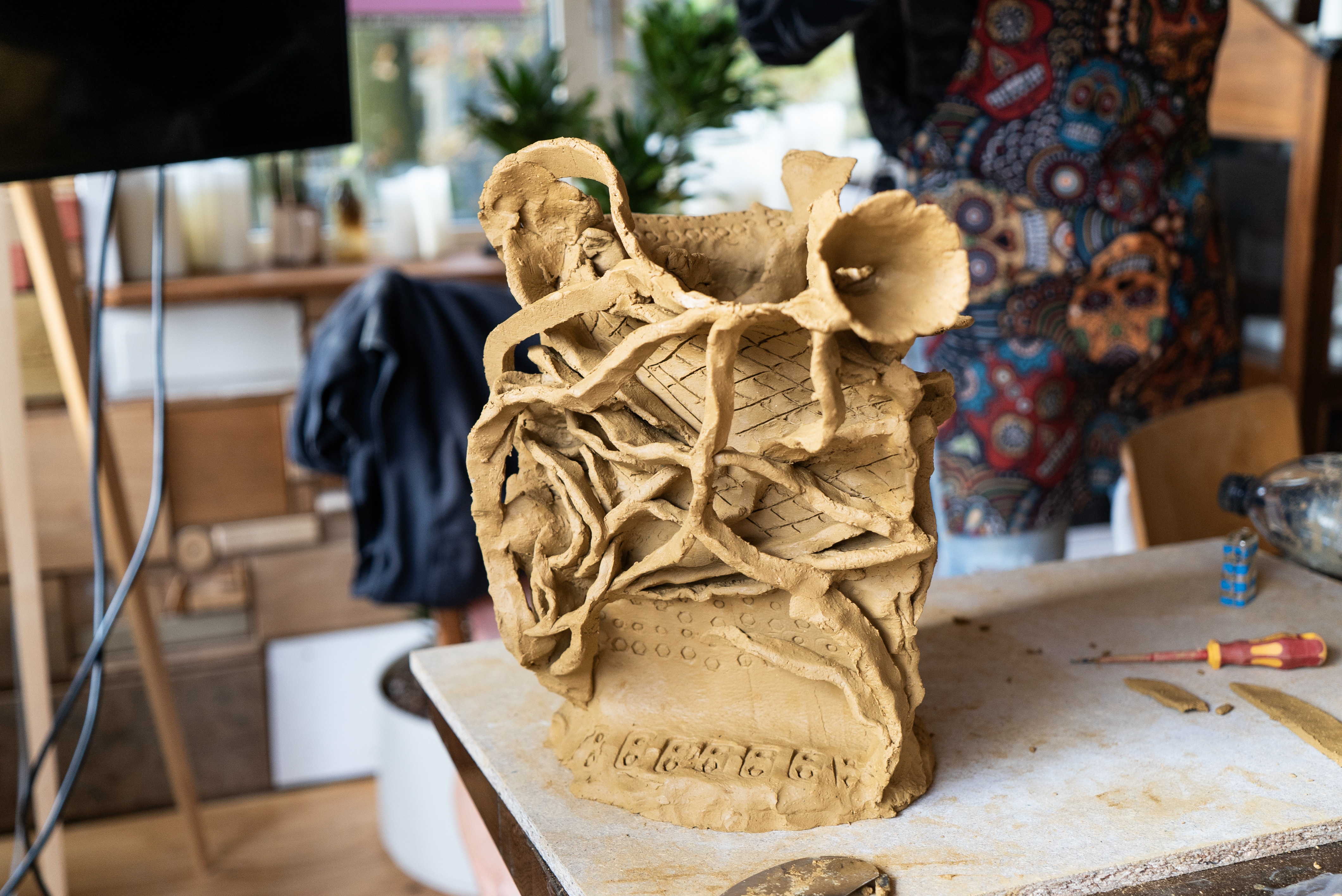
A workshop on creatively speculating (through fiction writing and ceramics making) cultures of energy. Every culture we imagine has distinct value systems, customs, ethics, technology, and beliefs on how electricity and energy are cultivated, valued, and consumed. The ceramic vessels we made are thought to be coming from these fictional cultures.




3rd workshop ‘Playing Bacterial Energy’
A workshop on tinkering with electronics that can be powered with the mud cells. Electricity generated by bacteria are low in amount and fluctuating with environmental conditions. We made use of energy harvesting circuits and creatively prototyped different sorts of devices that are powered by the mud.


